Latest News
From the Archives - Leonard Bernstein: America’s Music Director
Posted August 20, 2026
Leonard Bernstein: America’s Music Director
by Sedgwick Clark
As printed in the Spring/Summer 2014 issue of Prelude, Fugue & Riffs
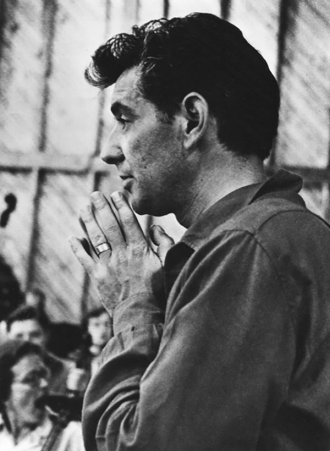
Photo © Gus Manos
Leonard Bernstein became an American folk hero at age 25 on November 14, 1943, standing in for an indisposed Bruno Walter on the New York Philharmonic’s weekly radio broadcast. His success made the front page of The New York Times. Fifteen years later, he would become the first American-born and educated music director of the Philharmonic, another front-page story. Today, over twenty years after his death — and unlike nearly all the stars of yesteryear — his recordings continue to sell well and his concert videos introduce him to new generations of music lovers.
He was always our Lenny — eternally youthful, inquisitive, charismatic, passionate, handsome, and brilliant, the smartest kid in class. His boundless affinity for music was obvious from the beginning, but his worried father urged his son to adopt a more practical livelihood. Later he would say, “How did I know he was going to be Leonard Bernstein?”
There seemed no end of his talent — a classically trained composer, conductor, and pianist, comfortable in jazz, folk, musical theater, and pop, who communicated with those varied audiences unlike any musician before or since.
He matured at a crossroads in the history of classical music. Television was overtaking the world, the LP and stereo technology were transforming the recording business, and classical music in America was on a roll. No one was better endowed to lead this revolution than Leonard Bernstein.
He was the antithesis of classical music’s stuffy image. The camera loved him. His impassioned conducting style captivated audiences, and he responded with programming of astonishing boldness and breadth, especially of the Twentieth-century and American masters — much of it captured for posterity on recordings.
In those pioneering days of live television, Bernstein hosted seven programs of the legendary Omnibus series (1954–58), all of which are available on DVD. Who could forget his debut: a revelatory analysis of Beethoven’s sketches for the first movement of his Fifth Symphony, filmed on a stage dramatically painted with a giant reproduction of the score’s first page? Bernstein’s ability to elucidate Beethoven’s compositional struggle for both the layman and musician revealed an inspiring teacher as well as a new media star.
The baby boomers were just entering their teens as Bernstein became the Philharmonic’s music director in 1958 and presented the first of his Young People’s Concerts with the orchestra. Fifty-two YPC programs of lectures and musical examples are available in a two volume DVD set, including the very first, “What Does Music Mean?” Universally praised for his enlightening, never condescending approach, he tackled such subjects as “What Is Sonata Form?”, “Musical Atoms: A Study of Intervals”, and “What Is a Mode?”— on national network television, no less! Programs devoted completely to such Twentieth-century composers as Stravinsky, Mahler, Sibelius, Shostakovich, and Copland undoubtedly paved the way to their acceptance today.
Evidence of Bernstein’s pervasive influence is everywhere. Little did I know, as I watched his programs in my hometown of Muncie, Indiana, that I would move to New York in time for his final season as Philharmonic music director and choose a career in classical music. Many fellow YPC goers have recounted similar epiphanies. The influence of these concerts extends to performers, of course. Alan Gilbert, the New York Philharmonic’s current (and first New York City-born) music director, is the son of two Philharmonic violinists and reminisces often of the inspiring Bernstein concerts he heard when growing up. Gustavo Dudamel, music director of the Los Angeles Philharmonic, unabashedly admits how much he learned from Bernstein’s recordings and videos when he was a boy in Venezuela. Baltimore Symphony Music Director Marin Alsop talks of her conducting studies with Bernstein at Tanglewood. They have all programmed their mentor’s music.
Indeed, Bernstein’s own music has never been more popular: His publishing agent, Boosey & Hawkes reports a consistent increase in performances of his compositions over the years, and new recordings of his concert works continue to proliferate. As a composer, he stuck to his tonal guns at a time when tonality was deemed old hat by many critics and academics. Today he’s a hero to the current crop of composers, whose music is determinedly tonal.
From an unquenchable need to realize the music’s greatness, and communicate that stature to others, he created music-making that never stood still. It was always evolving as he sought new insights, new ways to convey the composer’s message. He was always taking chances, always demanding more commitment from his players in service of the emotional core of the music. With vital rhythmic drive, unparalleled energy, and unflagging note-to-note intensity, there was never a neutral bar in a Bernstein performance.
Leonard Bernstein was the most influential musician America has produced. He still is.
--
Sedgwick Clark is the former editor of Musical America. He has written about Leonard Bernstein for The New York Times, BBC Music Magazine, and Prelude, Fugue & Riffs, among other publications.