Artful LearningHow It Works
How It Works
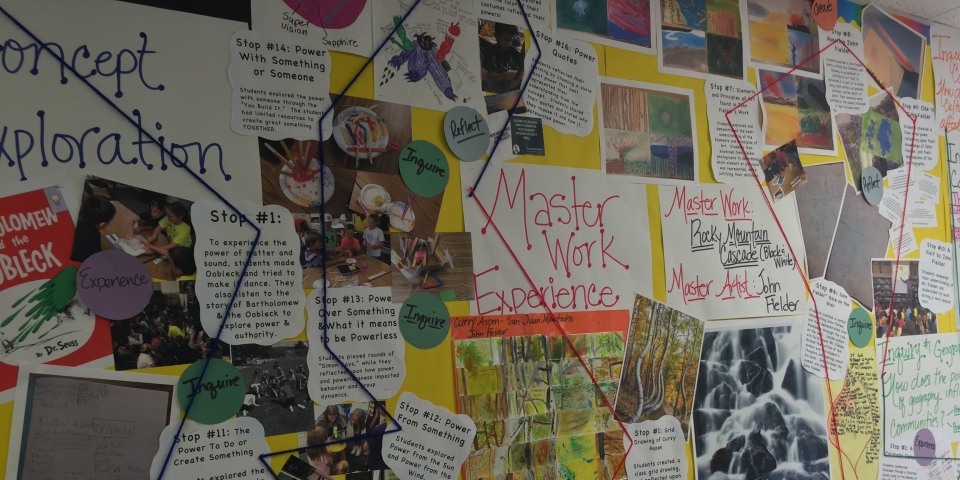
Artful Learning is built on an instructional sequence that students Experience across every discipline and grade level. The whole school becomes versant in the same methodology, which unites the students and teachers around what they do together every day in every classroom. Every unit is tied to a larger Concept, and students are introduced to a Masterwork that brings it to life, and a Significant Question which then drives their Inquiry. Through this, they are inspired to Create a work product and Reflect on what they have learned.

EXPERIENCE
Students engage directly with the Concept and the Masterwork that anchors it to a curricular standard. They listen, look, move, and respond—taking it in through multiple senses. The goal is to spark curiosity and open a doorway into deeper learning.

INQUIRE
Students pose and pursue significant questions: What does this mean? How does it connect to what I already know? Why does this matter now and why is it important for my life? They investigate through research, hands-on projects, and discussion. Teachers keep the inquiry focused while following student curiosity.

CREATE
Students, either individually or as a team, design and build an Original Creation—a written piece, a visual work, a performance, or a model—that expresses their understanding of the standard. In creating it they synthesize what they have learned; in presenting it they practice communication and public speaking.

REFLECT
Upon being presented with Deepening Questions, students document and interpret their learning: what they learned, how they demonstrated it, and how it connects to broader ideas and the world beyond the classroom. Reflection builds metacognition—students learn to think about their own thinking.
How Teachers Learn the Model
Teachers learn Artful Learning over three years through the same annual cycle: an immersive four-day Summer Institute, where they design their own Units of Study and practice implementing them, followed by two on-site trainings during the school year and ongoing remote support from Trainers. Over the three years, teachers move from understanding the model to integrating it into daily practice to becoming confident, independent practitioners—and at that point, the school is equipped to continue on its own.
RESULTS AND DATA
Over three decades of implementation, schools using Artful Learning report:
- Improved performance across academic subjects—reading comprehension, writing, mathematical reasoning, science, and social studies
- Higher-level mastery of curricular standards
- Increased growth on state achievement measures and stronger school-level performance relative to their districts
- Greater student engagement and motivation, and improved classroom behavior
- Stronger critical thinking, communication, and public speaking skills
- Improved teacher practice, greater staff collaboration, and renewed professional satisfaction
- A stronger school culture and sense of community
“I was able to teach my whole curriculum, and my kids left me reading. It was phenomenal. It was amazing, and I attribute every bit of that to Artful Learning and to keeping kids engaged.”
— Teacher, Vernon Hills, IL
Why It Works
Artful Learning works because it aligns with how people learn. When students engage with content through multiple senses and modes of expression, understanding is deeper and retention is stronger. When they must demonstrate what they know in a new form, they think more critically and communicate more clearly. When teachers have a coherent framework and expert support, they teach with more confidence. And when a school commits to three years, the change takes root.
GROUNDED IN TODAY’S EDUCATIONAL PRIORITIES
Artful Learning was not designed around any single trend, but it aligns with—and strengthens—five ideas shaping K–12 education today.
- Integrated, structured learning. Educators want instruction that connects disciplines around a coherent throughline. Every Artful Learning unit follows the same four-phase sequence, anchored to a single Concept and Masterwork that connects across subjects. Integration is how the model works, not an add-on.
- Learning as a skill. Because every unit follows the same structure regardless of subject, students internalize it as a transferable way of approaching new material. The Reflect phase builds the habit of thinking about one’s own learning.
- Writing to learn. In the Create phase, students often produce a written Original Creation as they work through a standard—using writing to clarify understanding, not just to demonstrate it afterward.
- Social and emotional learning. Collaboration, self-expression, and self-reflection develop through the academic process itself. Students inquire together, create individually, present to peers, and reflect on their own learning—the same skills SEL programs teach explicitly.
- The science of reading. Comprehension depends on background knowledge and vocabulary, not decoding alone. The Experience phase immerses students in a concept and its vocabulary before they read or write about it.
WHAT SCHOOLS ALREADY SPEND
Public schools in the United States spend an average of $16,280 per student each year. Of that, $828 per student goes to instructional staff support (curriculum development, staff training, libraries, and media centers) and $485 per student goes to classroom supplies and textbooks. For a middle school of 1,000 students, that is more than $1.3 million a year already committed to the things Artful Learning strengthens: teacher practice and the materials that shape it.
Source: National Center for Education Statistics, Digest of Education Statistics 2023, Table 236.60 (school year 2020–21, constant 2022–23 dollars).
The cost of bringing Artful Learning to a school totals $215,000 for each training year for three consecutive years: the $95,000 Artful Learning fee (the four-day Summer Institute, two on-site trainings during the school year, and ongoing remote support) plus a maximum of $120,000 in in-school costs (teacher pay for the Summer Institute, substitute coverage during the school-year trainings, and classroom materials).
Pulled from the estimated $1.3 million that same school already spends each year on instructional support and materials, it amounts to about 16 percent of existing outlay, or roughly $215 per student. And it is a finite 3-year investment. Once a school’s teachers are trained, the school continues on its own, carrying the method forward year after year with no continuing fee. What has been transformed is not the school’s budget but the return on it: every dollar the school will keep spending on professional development, instructional materials, and supplies now serves a proven method for turning standard curriculum into inter-disciplinary instruction that raises achievement.
Measured against that, three years of Artful Learning is a prudent investment in the teachers who shape every one of those dollars.