Latest News
Lenny & Steve
Posted March 17, 2026
Lenny & Steve
by Daniel Okrent
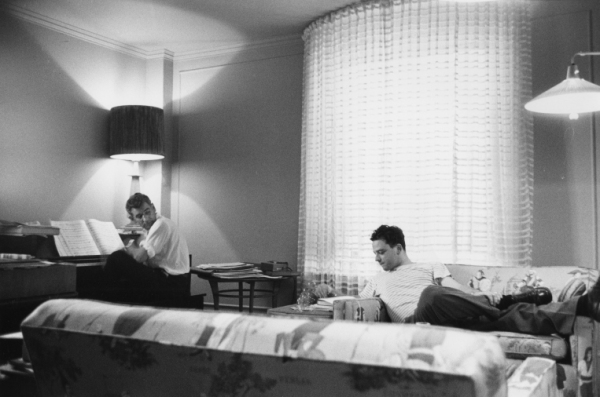
Photo: Leonard Bernstein and Stephen Sondheim working on West Side Story in Washington, DC, 1957. Photographer unknown.
When Stephen Sondheim met Leonard Bernstein in 1955, Sondheim was 25, Bernstein 37. At the time, one was a nobody; the other was both a towering figure in classical music and an outsize presence on Broadway. Bernstein wrote, “A young lyricist named Stephen Sondheim came and sang us some of his songs today. What a talent! I think he’s ideal for this project.” The project was a gestating musical called, at the time, East Side Story. Two years later, after West had replaced East and the show had opened on Broadway, Sondheim sent a letter to Bernstein on opening night: “Dear Lenny, You know—only too well—how hard it is for me to show gratitude and affection, much less commit them to writing.” He added, “Friendship is a gift I give or receive rarely, but for what it’s worth, I want you to know you have it from me always.”
This was not quite true. For the next quarter of a century, the two shared a profound and intimate bond. But in the late 1970s, their friendship began to waver, eventually declining into an almost passive connection. By the time Bernstein died in 1990, and in the years following, Sondheim would always acknowledge his debt to Bernstein—but not much more than that, at least not in public.
In the beginning, Bernstein’s generosity to Sondheim was expansive. By the time Sondheim came on board, Bernstein had already written lyrics to several of the show’s songs, and when it opened for a pre-Broadway tryout in Washington, D.C., the program said the lyrics were “by Leonard Bernstein and Stephen Sondheim.” But reviews of the production didn’t mention Sondheim at all. Dismayed, Bernstein decided to remove his own name from the lyrics credit. By then, few of his words remained in the show, and he genuinely wanted to focus the spotlight on his 27-year-old associate.
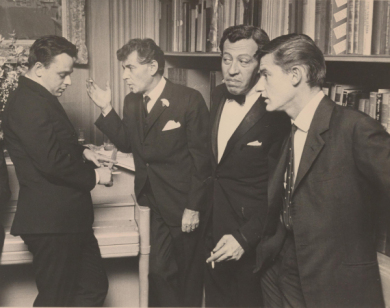
Photo:Stephen Sondheim, Bernstein, Adolph Green, and Roddy McDowall, June 1962. Courtesy of the Library of Congress Music Division.
But Sondheim considered himself a composer first, and a lyricist only secondarily. (In 1970, when Bernstein praised him—repeatedly—for the lyrics of Company, but refused to say a word about the music even when asked, Sondheim bristled.) They never worked together again, except for one failed effort that was never performed in public—but their attachment was nonetheless firmly cemented. Sondheim had soon become an essential figure in the glittering, Bernstein-centered social group he would later satirize in “The Blob,” from Merrily We Roll Along—the people who write the books/ And put on the shows/ And run the saloons/ And design the clothes—and were the red-hot center of New York’s literary and artistic elite. He grew especially close with Bernstein’s wife Felicia, and forged what would be lifelong attachments to the three Bernstein children. Raised in a completely secular Jewish home, Sondheim attended many Passover seders at the Bernstein home, and learned everything he knew about Israel from Bernstein, who also taught him how to pronounce the names of Jewish holidays. Sondheim was a devoted friend, deeply bound up in the Bernsteins’ lives. The two men even shared the same psychiatrist—who was, himself, a member of “The Blob.”
As the years passed, though, their career arcs crossed and their personal connection began to wither. Sondheim’s work had risen in both professional and public esteem, while Bernstein’s reputation as a composer had declined. Their mutual friend, playwright John Guare, said, “As Steve got more famous, Lenny became more hostile.” In 1978, Bernstein bitterly told a mutual friend that Sondheim’s bloody and brilliant Sweeney Todd was “disgusting” and “enough to make you want to throw up in your galoshes.” And, he sneered, “Steve finally got to write a musical that suits his temperament perfectly.” Their friendship soon devolved into a pale version of itself. Bernstein’s growing dependence on amphetamines didn’t help. Sondheim did write the lyrics of an affectionate birthday song for Bernstein’s 70th birthday, but the two men had dinner together only once or twice a year. That was it.
After Bernstein’s death in 1990, Sondheim occasionally disparaged Bernstein in interviews. He felt Bernstein had tried so hard, and so unsuccessfully, to be current with the culture that he could have been called, Sondheim said, “Rip van Withit.” By way of evidence, Sondheim described the rock music for Bernstein’s Mass as “actively embarrassing.” He derided his old friend’s “self-importance” as “both embarrassing and silly.”
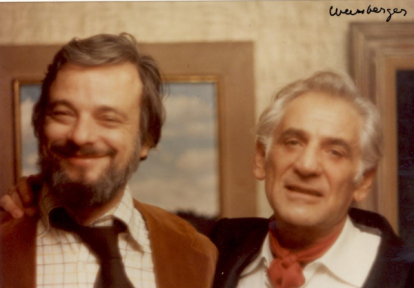
Photo: Stephen Sondheim and Leonard Bernstein, 1978. Photographer: Weissberger / Courtesy of the Library of Congress Music Division.
But: Sondheim remained close with Bernstein’s children until his own death in 2021, and to them he spoke lovingly of their father. As Sondheim entered his eighties, he praised Bernstein in his two annotated books of lyrics, Finishing the Hat and Look, I Made a Hat. Late in life, no longer bruised by Bernstein’s disapproval of his music, and no longer beset by resentment, Sondheim seemed to remember those words he had written back in 1957. “Friendship is a gift I give or receive rarely,” he’d told Bernstein, and “I want you to know you have it from me always.”
Or, almost always.
--------------
Daniel Okrent is the author of seven books, most recently Stephen Sondheim: Art Isn’t Easy (2026), and a former public editor of The New York Times. A distinguished editor and historian, he has also held senior roles at Time Inc. and received major honors for his work in American history.