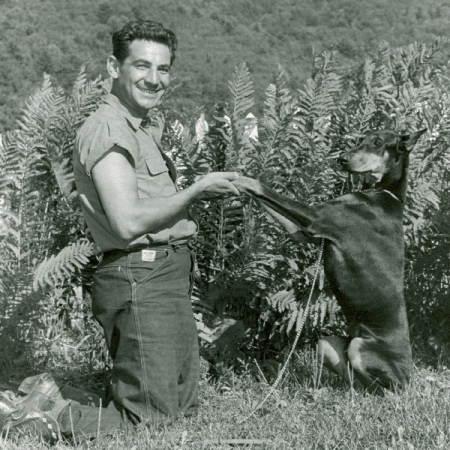
Leonard Bernstein's
Young Peoples Concerts
with the
New York Philharmonic
What Does Music Mean? (#8000)
Read the script!
Original Broadcast: January 18, 1958
Even if a composer deliberately writes music to follow a story line, the ultimate "meaning" of great music is not the story but the sounds themselves -- and all the underlying emotions and feelings that the composer has worked to express. Those emotions are not "extras," but an integral part of the music. In fact, they are what the music is all about.
La Valse (Ravel), plus excerpts from William Tell Overture (Rossini), Don Quixote (Richard Strauss), Symphony No. 6 "Pastorale" (Beethoven), Pictures at an Exhibition (Mussorgsky), Symphony No. 4 and Symphony No. 5 (Tchaikovsky), and Six Pieces (Webern).
What Is American Music?
Read the script!
Original Broadcast: February 1, 1958
U.S. composers give their music certain characteristic American sounds: the loud optimism of youth; the open-spaced loneliness of the wild West; the sweetness of church hymns; Latin American color and snap; cool African-American syncopation. These musical accents let you feel what it means to be an American -- a descendant of all the nations on Earth.
Excerpts from An American in Paris and Rhapsody in Blue (Gershwin), Symphony No. 5 (Dvorák), Dance on Place Congo (Gilbert), American Festival Overture (William Schuman), Symphony No. 3 (Harris), Symphony No. 2 (R. Thompson), Mother of Us All (V. Thomson), and Music for the Theatre, Billy the Kid, and Symphony No. 3* (Copland) *(conducted by Aaron Copland)
What Is Orchestration?
Read the script!
Original Broadcast: March 8, 1958
How might you arrange music for a whole orchestra to play? This program shows you the rich variety of choices you face. You need to know what all the instruments can do, and how to handle the instruments alone and together. You need a sense of style, too. Dressing your music in the wrong style, Mr. Bernstein says, is like "putting on a sweater to go swimming!"
Bolero (Ravel) plus excerpts from Capriccio Espagnole (Rimsky-Korsakov), Serenade for 13 Instruments (Mozart), Fantasy on a Theme of Thomas Tallis (Vaughn Williams), Symphony for Strings (William Schuman), and L'histoire du Soldat (Stravinsky).
What Makes Music Symphonic? (#8001)
Original Broadcast: December 13, 1958
Unlike pop music, symphonic music takes simple musical themes and then "develops" them -- that is, changes and expands them -- in a dazzling variety of costumes. To "dress up" music symphonically the composer may rearrange the notes, add chords, change the pitch, modify the tempo, play one theme against another... the possibilities are endless.
Excerpts from Symphony No. 4 (Tchaikovsky), Symphony No. 3 (Beethoven), Symphony
No. 104 (Haydn), Symphony No. 41, "Jupiter" (Mozart), and Symphony No. 2 (Brahms).
What Is Classical Music? (#8002)
Read the script!
Original Broadcast: January 24, 1959
To music teachers, "classical" music is really the music of 18th Century Europe, which was formulated by Bach and Handel in a strict, almost mathematical style. Later, Haydn and Mozart changed the formula to add grace and elegance. Still later came Beethoven, a genius who broke all the rules and ushered in the Romantic period.
"Egmont" Overture (Beethoven) and Overture to The Marriage of Figaro (Mozart), plus excerpts from Symphony No. 102 (Haydn), Symphony No. 40 (Mozart), Brandenburg
Concerto No. 4 (Bach), Water Music (Handel), and Piano Concerto No. 21 (Mozart).
Humor in Music
Read the script!
Original Broadcast: February 28, 1959
Can music be funny? Of course it can, and this program will show you the many delightful ways this can be true. A simple form of humor is imitation of nature -- there is even a musical sneeze! Other approaches to humor include sudden pauses, abrupt louds and softs, fast scurrying themes -- and the musical pun, which promises one thing but delivers another.
Excerpts from Symphony No. 88 (Haydn), Classical Symphony (Prokofieff), Symphony No. 1 (Mahler), "Polka" from The Golden Age (Shostakovich), Music for the Theatre (Copland), Symphony No. 4 (Brahms), and from works by Walter Piston, Paul White, George Gershwin, Wolfgang Amadeus Mozart, Zoltán Kodály, Richard Wagner, and Richard Strauss.
What Is a Concerto?
Read the script!
Original Broadcast: March 28, 1959
Audiences in the 1700s were fond of the "concerto grosso" -- a piece written for a big orchestra that was accompanied by a little orchestra. Over the centuries, the little orchestra shrank -- right down to a single player. The concerto as we know it today is often an orchestral piece with a brilliant "showoff" part for a particular solo instrument.
Excerpts from Concerto in C major for Diverse Instruments (Vivaldi), Brandenburg Concerto No. 5 (Bach), Sinfonia Concertante for Violin, Viola and Orchestra (Mozart), Concerto for Violin & Orchestra (Mendelssohn), and Concerto for Orchestra (Bartók).
Who Is Gustav Mahler?
Read the script!
Original Broadcast: February 7, 1960
You'll think of Gustav Mahler as an old and dear friend once you learn what's behind the composer and his music. In every aspect of his life, Mahler was a double man: sad grownup and innocent child; suave Westerner and gypsy-like Easterner; flowery romanticist and bold modernist; master of chamber music sounds, yet composer for some of the biggest orchestras in history.
Excerpts from Mahler's Symphony No. 4, Symphony No. 2, Das Lied von der Erde, and Des Knaben Wunderhorn. Soloists: Reri Grist, Helen Raab, William Lewis.
Folk Music in the Concert Hall
Read the script!
Original Broadcast: April 9, 1961
Lovers of simple tunes, rejoice! This program offers convincing proof that folk songs and folk dances are the heart of all music, even great symphonic works. As you'll learn, folk music starts with the speech rhythms and accents of a particular people. Gradually those speaking rhythms pass into folk music, then into the "art music" of concerts and operas.
Sinfonia India (Chavez), Songs of the Auvergne (Canteloube), Symphony No. 2 (Ives), plus excerpts from Symphony No. 39 (Mozart). Marni Nixon, soprano.
What Is Impressionism?
Read the script!
Original Broadcast: December 1, 1961
The Impressionistic concert pieces of Debussy and Ravel are the musical counterpart to the dreamy paintings of Monet, Degas, and Renoir. Like the paintings, this music draws on the French notion that suggestion can be more powerful than realism. Impressionistic music uses special scales and unique chords to achieve a misty, ethereal sound.
La Mer (Debussy) plus excerpts from Daphnis and Chloé (Ravel).
Happy Birthday, Igor Stravinsky
Read the script!
Original Broadcast: March 26, 1962
This program, celebrating Igor Stravinsky's birthday, shows how the Russian composer kept switching styles. He wrote luscious music for big orchestras, then tricky pieces for small orchestras, then "neo-classical" pieces, then something strange called twelve-tone music. At age 80, Stravinsky was still handing out the biggest surprises in the world of music.
Petrouchka (Stravinsky) plus illustrations from other works.
What Is a Melody?
Read the script!
Original Broadcast: December 21, 1962
A tune is a simple piece of music you can hum or sing. Symphonic music often starts not with a tune, but with several shorter fragments, which are then woven into melody. An orchestra may also play two different melodies at the same time, yielding a fascinating tapestry of sound known as counterpoint.
Excerpts from Prelude to "Tristan and Isolde" (Wagner), Symphony No. 40 (Mozart), Concert Music for Strings and Brass (Hindemith), and Symphony No. 4 (Brahms).
The Latin American Spirit
Read the script!
Original Broadcast: March 8, 1963
Latin American music draws its rhythm from an insistent underlying beat with complicated overbeats. It draws color from maracas, claves, gourds, rasping sticks, and bongos. And it draws melody from Indian, African, Spanish, and Portuguese folk themes. These elements, brilliantly intertwined, yield the vivid sound of Central and South American music.
"Batuque" from Malazarte (Lorenzo Fernândez), Bachiana Brasileira No. 5 (Villa-Lobos), Sensemayá (Revueltas), "Mambo" from West Side Story (Bernstein), and Danzón Cubano (Copland). Netania Davrath, soprano.
Jazz in the Concert Hall
Read the script!
Original Broadcast: March 11, 1964
Jazz has worked its way deep into the American soul, forever changing our popular and symphonic music. This fascinating program features a piece by the American composer Gunther Schuller -- a kind of Peter and the Wolf of jazz. Here a jazz combo joins the symphony orchestra.
Journey Into Jazz (Schuller) (conducted by Gunther Schuller), Concerto for Piano and Orchestra (Copland) (Aaron Copland, pianist), and Improvisations for Orchestra and Jazz Soloists (Austin). Soloists: Don Ellis, Joseph Cocuzzo, Richard Davis, Benny Golson, Eric Dolphy.
What Is Sonata Form?
Read the script!
Original Broadcast: November 6, 1964
A plain old song often unfolds as three basic parts: A-B-A. Amazingly, a typical sonata movement is just an expanded version of the ordinary, everyday song. To add drama to the sonata, the composer moves between related musical keys. Once you can pick out the A-B-A sections and the changing keys, you'll be an expert on sonata form!
Excerpts from Symphony No. 41, "Jupiter" and Piano Sonata in C Major (Mozart), Classical Symphony (Prokofieff), And I Love Her (Lennon & McCartney) and Carmen (Bizet). Veronica Tyler, soprano.
A Tribute to Sibelius
Read the script!
Original Broadcast: February 19, 1965
Jean Sibelius, Finland's most famous composer, came of age at a time when his country was dominated politically by Czarist Russia and culturally by Sweden. Sibelius's inspiring Finlandia so excited Finnish nationalists that the Czarist government banned it from the concert hall. This music did more for Finnish independence than a thousand speeches and pamphlets.
Excerpts from Sibelius's Finlandia, Violin Concerto, and Symphony No. 2. Sergiu Luca, violin.
Musical Atoms: A Study of Intervals
Read the script!
Original Broadcast: November 29, 1965
An "atom" of music is not a single note at all, but at least two notes. That two-note relationship, or interval, is the heart and soul of music. In this program you'll learn that intervals work to create two quite separate phenomena: melody and harmony. If you grasp just these two points, there is nothing in music you won't be able to understand.
Excerpts from Lohengrin (Wagner), Help (Lennon & McCartney), Symphony No. 4 (Brahms), and Symphony No. 4 (Vaughn Williams).
The Sound of an Orchestra
Read the script!
Original Broadcast: December 14, 1965
A great orchestra should not have its own sound, piece after piece, year after year. What makes an orchestra great is its ability to change at will. Since every composer has a unique sound, that is what the orchestra must strive to deliver. This program shows you how a great orchestra does this, and how it avoids committing certain common musical "sins."
Excerpts from Symphony No. 88 (Haydn), Symphony No. 1 (Brahms), Iberia (Debussy), L'histoire du Soldat (Stravinsky), An American in Paris (Gershwin), and Rodeo (Copland).
A Birthday Tribute to Shostakovich
Read the script!
Original Broadcast: January 5, 1966
The shy Russian composer Dmitri Shostakovich wrote provocative music. This program focuses on his Ninth Symphony, the funniest piece he ever composed. By tradition a ninth symphony is long and serious, but Shostakovich's Ninth is short and full of wisecracks. Listening to this piece is "like sitting down to a banquet and being served hot dogs and potato chips!"
Symphony No. 9 (Shostakovich) plus excerpts from Symphony No. 7.
What Is a Mode?
Read the script!
Original Broadcast: November 23, 1966
Much of the music we love best is based on ancient musical scales called modes. The Dorian mode can give basically Western music a formal, Asian sound. The Phrygian mode lends a sad quality to Spanish and Hebrew music. The Lydian mode adds a sharp, lemony tang to Polish dances. Each of the eight modes imparts its own distinctive sound. (Color)
Fętes (Debussy), "Polonaise" from Boris Godunov (Mussorgsky), and "Danzón" from Fancy Free (Bernstein).
A Toast to Vienna in 3/4 Time
Read the script!
Original Broadcast: December 25, 1967
This lighthearted introduction to the great music of Vienna starts with a dance tune in 3/4 time: a Johann Strauss waltz. Perfected in Vienna, 3/4 time is elegantly simple -- three beats to a measure. Relax and enjoy 3/4-time selections from Mozart, Beethoven, Richard Strauss -- and Mahler, who built bridges between the Romantic period and the 20th Century. (Color)
Wiener Blut (Johann Strauss), German Dance K. 605 No. 3 and Minuet from Symphony No. 41, "Jupiter" (Mozart), Three Songs from Des Knaben Wunderhorn (Mahler), Rosenkavalier Waltzes (Richard Strauss), and Scherzo from Symphony No. 7 (Beethoven).
Soloists: Christa Ludwig, Walter Berry.
Quiz Concert: How Musical Are You?
Read the script!
Original Broadcast: May 26, 1968
After hearing a four-minute "mystery" piece, you'll be invited to guess the composer's name and nationality and the period, style, and form of the music. Next you'll hear familiar pieces of music played in various incongruous ways, and you'll be asked to figure out what the musicians are doing wrong. Unlike most tests, this musical quiz is offered in a spirit of fun. (Color)
Berlioz Takes a Trip
Read the script!
Original Broadcast: May 25, 1969
The Symphonie fantastique, a musical illustration of obsessive, unrequited love, was conceived by French composer Hector Berlioz when he was 26. The yearning "theme of the beloved" rises higher and higher before it crashes. No matter where the music goes, "she," the beloved, keeps returning in endless forms and shapes. (Color)
Excerpts from Symphonie fantastique (Berlioz).
Two Ballet Birds
Read the script!
Original Broadcast: September 14, 1969
Who says ballet music is not good without the ballet? This program concentrates on two ballet scores, Tchaikovsky's Swan Lake and Stravinsky's Firebird. Both are filled with magic. Both are about birds. And both illustrate the triumph of love over evil. Swan Lake is abstract ballet music, while the Firebird score directly portrays a story. (Color, Stereo)
Excerpts from Swan Lake (Tchaikovsky) and Firebird Suite (Stravinsky).
Fidelio: A Celebration of Life
Read the script!
Original Broadcast: March 29, 1970
Although Fidelio was the only opera Beethoven ever wrote, it turned out to be one of his greatest works. The hero of Fidelio is a nobleman unjustly locked in a dungeon. The heroine is the nobleman's loving wife who, in a plot to set him free, dresses as a boy and takes the name Fidelio. The opera's final scene is worthy of a Western thriller movie. (Color, Stereo)
Excerpts from Fidelio (Beethoven). Soloists: Forest Warren, Anita Darian, Howard Ross, and David Cumberland.